Sapient Races In The Chakat Universe
by Bernard Doove © 2018 – 2024
This page is basically a list of the sapient species of my Chakat Universe. Although there are a few more than those listed so far, I have either not written about them yet, or found the need to describe them. As this happens, I will add them to the list.
Each species has a brief description of what they most resemble, NOT what they actually are, plus their most significant achievements.
- Caitians: Felinoids – savannah-type cats. Native to the planet Cait (Terranglo version of Kà'iît which translates roughly to "Sunfilled Land"), a generally hot and dry world. Males and females have the same full-grown average weight and height (digitigrade stance), which is about 150cm (~4' 11"). Females have very thick long hair, while the males' hair grows into a lion-like mane as he matures. Females always wear their hair long and rarely bound due to their cultural beliefs. Their tufted tails are thick and strong, and are used for balance and as a prop while they are standing stationary. Their hands and feet only have four digits each. They have very short fingers and tend to use their claws for fine manipulation. For the full details on this species, please read Caitian Confidential.
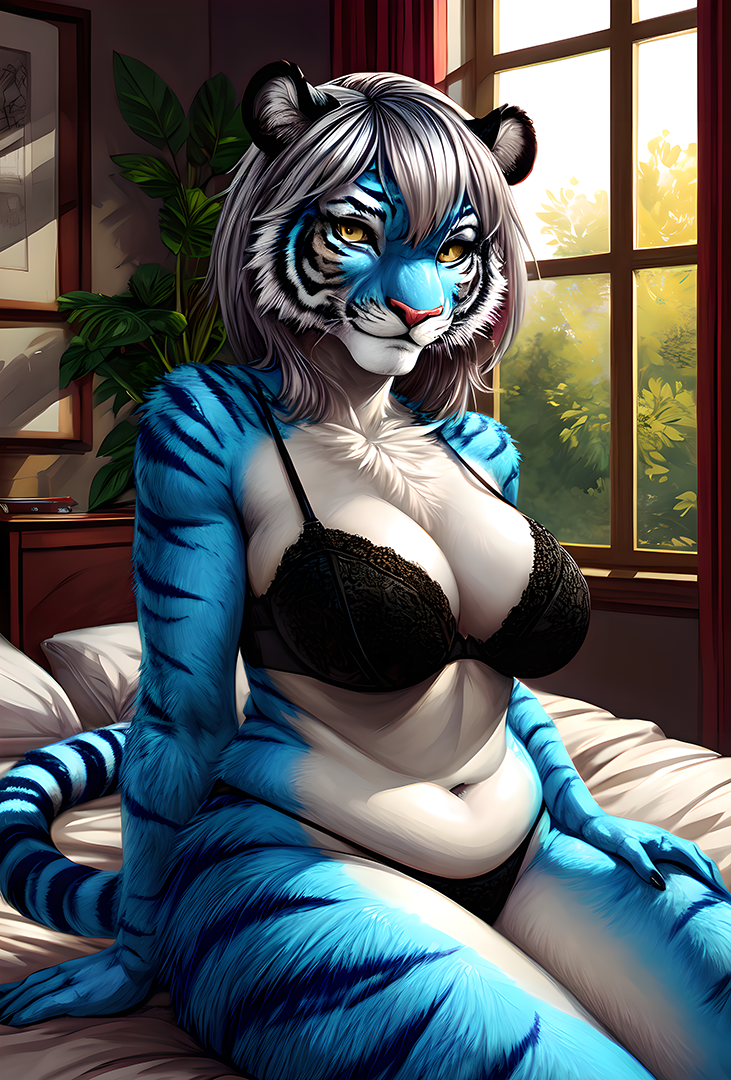 Rakshani: Felinoids – jungle cats with tiger-like patterning, but coming in many different colours than tigers, and with some very different stripes not at all like tigers. Native to the planet Raksha. Full grown height (digitigrade stance) ranges between 213cm (7 feet) and 234cm (7' 8"). Most female Rakshani have head hair, but not all, whereas the males never do. Their very long and thick tails are not only used for balance, but as powerful club-like weapons. It is thought that the Rakshani evolved to pounce on large prey and entangle the legs with the tail, then use the bony knob on the end to stun or even kill it. The thick fur protects the tail and disguises the knobbed end. Males and females grow to the same average height, but the males are more heavily muscled and stronger than the females, while the females are more flexible and agile than the males. They are an agressive but honourable species, extremely protective of children due to the high mortality rate. Adult females tend to be exceptionally busty, even by Terran standards; this is due to the vastly different structure as evolved to cope with constantly breeding to replace the children that die young. Whereas human (and thus morph) breasts are roughly 10% muscle and 90% fatty tissue, a Rakshani female's breasts consists of a sac surrounded by muscle and covered with a protective layer of fatty tissue. The sac acts more like an udder to store milk, while the muscle not only supports the breasts but, when feeding a cub, also squeezes the sac to express milk from the nipple. Cubs do not suckle – the mother squirts the milk into her child's muzzle. Millenia of constant feeding has led to females evolving to constantly produce milk after they give birth for the first time, and if the milk is not used, it must be expelled to prevent overfilling the sacs, which causes great pain. The milk can be put to many uses, but the females tend to drink it to regain the nutrients lost to the milk. The layer of protective fatty tissue tends to give the breasts a shape that is very similar to well-endowed Terran species. The same need to constantly breed has also evolved non-pregnant females to have a strong reproductive imperative during their heats, which requires them to seek sexual relief from their mates. However, with the growth of civilisation and an improvement in the child mortality rates, the need to allay that need without producing more unwanted children resulted in the development of the Danzhouken – infertile males skilled at giving pleasurable and satiating sexual intercourse. The penises of Rakshani males resemble that of humans except for a series of ridges below the head. The penis resides in a sheath, but they do not have scrotums. (In fact no Rakshan species has a scrotum because evolution took a different route on that world.)
Rakshani often take military and command roles, but are also skilled educators. They are a very passionate species, and have a strongly militaristic society, comparable to Star Trek's® Klingons in many ways, but unlike them they strongly value other things besides warriors. They especially value their experienced and wise elders, and their 'Houses' are usually named after particularly honored members. Relationships between males and females start off by either one trying to beat the other at some skill, or greatly impress them in some way. Idle boasting is always ineffectual, and Terran-style pick-up lines leave them cold. There is no gender bias as to who tries to impress whom. Due to the high mortality rate, it became common tradition to not give a child a formal name until his or her second birthday. Family loyalty is always to their House, and many families can be part of those Houses. Both males and females can marry into another House. Many Rakshani can be found in Star Fleet (not as many in the Star Corps), and they frequently end up on front-line battleships of various kinds. Extremely sneaky strategists. Nearly went to war with the Stellar Federation before negotiations through Caitian and chakat diplomats forged an alliance. Their engineering tends to be unsophisticated, but extremely durable. The Rakshani have only one religion – they worship their Deities. The reason that they only have one religion is because their Deities are in fact an elder race that have evolved beyond the physical, but still make their presence known by frequently doing many otherwise impossible things. With that sort of undeniable presence, there was never any doubt about their existence, and whether they answered the prayers of the Rakshani. The only differences between the various Rakshani cultures is in the way they worship the Deities. The Fertility Festival is one of the most famous (or perhaps infamous) ones.
Most of the living species except the Kalen-toth are regular visitors to the other worlds in the Federation, and the Rakshani are fairly aggressive colonisers. They met the humans when both sought to claim a new world. Fortunately, negotiation with Caitian and chakat diplomats made them allies rather than enemies. Humans are the great exploring species, partnered with all the morph species that they created, including Chakats, who are in their element exploring new worlds.
A recent addition to the universe are the people of Equus, the world of magic and creatures of legend. These include:
- Ponies: These consist of unicorns, pegasi, earth ponies, crystal ponies,and alicorns. Ponies are the dominant species of the world.
- Griffons: The second-largest race on Equus.
- Changelings: Third-largest population.
- Zebras
- Dragons
- Kirin
- Yaks
- Hippogriffs
- Minotaurs
- Diamond Dogs
- Tanuki
- Yeti
Return to Introduction To Chakats.
Return to Story Index.
Return to main Den page.